
In an attempt at self-improvement, I’m trying to teach myself some basic electronics.
I was fascinated by electronics when I was a kid. I remember my parents had given me a Science Fair electronics kit, which was a shallow wooden box that had electronic components mounted inside, with spring terminals wired to each of the leads. You could wire components together by bending the springs and sticking the ends of wires between the coils to clamp them in place. Although it’s not the one I had, here’s a similar kit:
I remember I was able to follow the instructions and do many of the experiments, but I was too young to understand what the components did, let alone how the circuits worked.
By the time I was old enough to learn electronics for real, I was more interested in computers and software. I’ve taken a course in digital electronics, but I never really tried to learn traditional analog electronics. I have some vague understanding of what voltage and current are, and I know that resistors reduce current flow, capacitors store charges, and transistors control…something… But why you’d want to do some of those things, or how the components work together to make circuits, that’s beyond me.
I’m trying to close that gap in my knowledge using Charles Platt’s well-regarded book Make: Electronics: Learning Through Discovery, 2nd Edition. I bought some of the parts kits that go with the book (much easier than tracking down individual components myself) and I’m working my way through the experiments. I skipped one or two of the simple ones at the beginning, but I’ve been doing most of the rest on the theory that even if I think I understand the principles from the text, the lessons will stick in my memory better if I actually build the circuits.
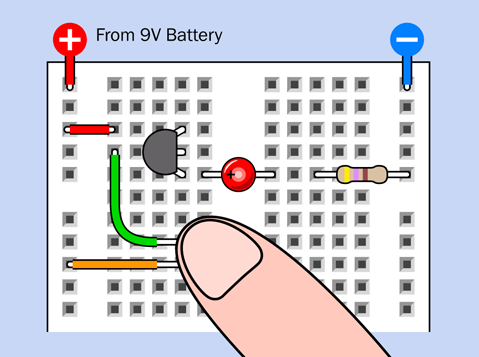
I’ve just now reached the section that explains what a transistor does, and I built this circuit on my breadboard:
The concept is simple: The transistor (the little black thing) is mounted so that the 9-volt battery is connected to the collector pin (top lead). The emitter pin (bottom lead) is connected via the breadboard through a red LED light. With the transistor in the off state, no current flows through it from the collector to the emitter, so the led is off.
When I touch my finger to the two exposed wires, the 9-volt battery pushes a small current through my finger and into the base lead (middle pin) on the transistor. This turns it on, and current begins to flow from the collector to the emitter, which causes the light to glow. The current flowing through my finger is very small — too small to light the LED itself — but the amount of current let through by the transistor is many times larger, and it’s enough to light the LED. The effect is proportional, so if I press harder, allowing a little more current to flow through my finger, the LED gets brighter. Basically, the transistor amplifies the current.
The transistor is of a type with the generic designation 2N2222, which was originally made by Motorola starting in 1962. Its use in this circuit demonstrates, in the most basic sense, the principle by which incredibly weak radio signals striking an antenna can be amplified to produce sound. This is what made portable transistor radios possible.
Like many transistors, this one requires a 9-volt power source. Since regular AAA, AA, C, and D batteries are single cells which only produce 1.5 volts, it would have required six such batteries to power a radio. To make powering small electronics devices simpler, battery manufacturers invented a special battery that had six tiny 1.5 volt cells inside it to deliver the 9 volts that transistors needed. These are the familiar squarish batteries that look like this:
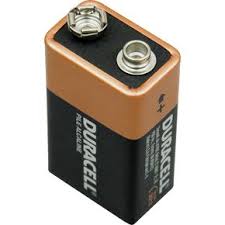
So it’s because these batteries were invented to power radios that used transistors like the one in my experiment that these batteries are still commonly referred to as “transistor radio batteries.”
I just thought that was neat and felt like sharing.
[…] am continuing my attempt to self-educate myself at electronics by working through Charles Platt’s book Make: Electronics: Learning Through Discovery, […]