
In the two previous posts in my amateur exploration of the stimulus (GDP, and then Recession), I explained what a recession is and what many economists think causes one. Now I’m going to try to explain my understanding of what a solution has to do, and why some people think a stimulus package is a good idea.
(This series of posts is my first attempt to write anything about macroeconomics, so if I’ve screwed this up, let me know in the comments.)
The problem, as you may remember, is that the population has a whole is trying to save money and is therefore not spending any. This reduction in aggregate demand leads to a decline in production and therefore in employment, causing much misery.
(There are some other theories about how recessions happen, but this theory is the one that seems to be behind the current stimulus package.)
The solution, in general, is to find a way to push aggregate demand back up to the normal level. This will happen naturally as struggling people and firms bid down wages and prices. With the same amount of money chasing lower priced production, consumption will eventually rise again.
But “eventually” is a long time. Is there something we can do to speed things up?
The best solution would be to have the CIA fire up their mind control machines and force all Americans to increase their consumption purchases back to the level they would have consumed at if there wasn’t a recession. Since everyone’s spending will support everyone else’s income, we should skate right over the recession.
There are two problems with this approach. First, there’s no such thing as CIA mind control (or so they told me to say). Second, people should only resume normal consumption to the extent that they reduced consumption due to fear of a systemic economic problem. To the extent that people reduced consumption due to fear of an actual personal economic problem—losing a big client, working on a product that has gone out of style, getting too old to star in porno films, etc.—they should continue the prudent path of reducing their consumption. This second problem also affects every other approach we will explore.
If we can’t use CIA mind control to force consumers to spend more, perhaps we can simply persuade them, either by talking up the economy or by directly asking people to consume more. I’m pretty sure that President George W. Bush had this in mind when shortly after the 9/11 terrorist attack he clumsily urged Americans to “go shopping.”
It seems doubtful that talking up the economy will actually work. When an elected official or one of his minions starts talking about how great things are, we tend to assume that he’s just campaigning for re-election.
On the other hand, we seem to respond fairly predictably to fear, so I think our leaders can really hurt the economy by talking it down. It can’t have helped consumer confidence in their economic future when Treasury Secretary Henry Paulson practically wet himself over the bank crisis.
If we can’t force people to spend more, and we can’t talk them into it, maybe we can trick them into it by making them feel richer. Crank up the presses at the Bureau of Printing and Engraving, print up $1 trillion in hundred-dollar bills, and send about $3000 in cold hard cash to every man, woman, and child in America.
It won’t make anyone any richer—printed money has no intrinsic value, and printing a lot of it has no immediate effect on GDP—but maybe it will make people feel richer. They’ll become more free with their money and buy more stuff, aggregate demand will rise, and people will go back to work to produce all the stuff we’re buying. The recession will be over.
With a few tweaks, this is actually the first workable idea I’ve described. In fact, we already have the Federal Reserve working on it. Rather than mailing out packages of cash, the Fed manipulates the money supply through large-scale transactions in goverment securities, loans to member banks, and adjustments to certain banking regulations, with the goal of driving down the interest rates banks charge each other for short-term loans of cash. This has the same effect on the money supply as sending out piles of cash, but it’s far easier to do.
In fact, the Federal Reserve has been doing this for decades, lowering interest rates to fend off a recession, and then raising them to fend off crippling levels of inflation. (Increasing the money supply doesn’t directly increase GDP, so if there’s more money chasing after the same amount of stuff, it drives up prices.)
The problem is, the Fed has nowhere to go. The current target interest rate is essentially 0%, meaning the Fed is happily pumping up the money supply whenever it can. This has never happened before. Clearly, while manipulating the money supply—monetary policy—is a workable idea, it’s not enough to fend off the current recession.
(Some people think the real problem is that having the Federal Reserve manipulate the money supply is not a workable idea, and that any appearance of success is just blind luck. This seems unlikely to me, but it’s not something I’m confident about.)
The failure of the Fed to fix the problem with monetary policy leads us to reconsider one of the ideas I mentioned earlier: Forcing people to spend money.
The good news is that even the crazy people in Washington realize they can’t create a Department of Spending to send out men with guns to force us all to spend money. The bad news is that they don’t need to. They have the IRS.
Recall my line diagram:
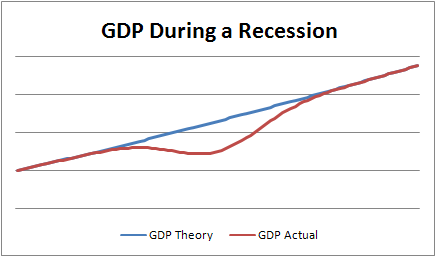
Instead of encouraging us to spend more money, the government can simply take the money from us and spend it directly. If we won’t push our spending up from the red line to the blue line, they’ll take our money and do the necessary spending on our behalf.
This doesn’t require quite as much spending as you’d think, because the same multiplier effect that helped speed the crash will also help with the recovery. The people who benefit directly from the government spending will go on to spend some of the money they receive, which will add to somebody else’s income, who will go on to spend more money, and so on. This allows a relatively small amount of spending to make a difference.
The multiplier effect also adds a complication, because different ways of spending the money will likely have different multipliers. Pundits are discussing whether government spending has a better multiplier than private spending, whether poor people have a better multiplier than wealthier people, and whether you get a better multiplier from one quick burst of spending or from a long-term spending program.
Next: Problems with the stimulus.
Leave a Reply