
I want to bloviate about the economy and the stimulus a bit, so I’m going to try to explain our current unpleasantness as I understand it. My economic knowledge is purely amateur, so if you think I’m wrong, let me know. (And if you think my explanation is so bad it’s not even wrong, let me know that too.)
The U.S. Gross Domestic Product (GDP) is, roughly speaking, the value of everything produced in the United States in one year including all the goods and services that make our lives better—from food, clothing, and medicine, to booze, music, and television. GDP is not the economist’s final end-all measure of success, but it’s probably the best estimate of success. (GDP also includes the production of capital goods, exportable goods, and whatever the government does, but those don’t participate much in the story I’m trying to tell.)
In normal economic times, GDP increases slowly as time goes by. In part, this is simply because the U.S. population is increasing and therefore the size of our labor force is increasing. More workers are producing more goods and services.
GDP also grows because of increases capital. Note that to an economist, capital does not mean money. Rather, capital is the means of production, anything that makes it possible for workers to produce stuff for someone to consume.
A can of tuna in your pantry is the final consumer good, and a tuna fish in the ocean is raw material, but everything used to turn that fish into that can of tuna is capital, including the fishing boat used to catch the fish, the forklift that move the fish into the canning plant, the canning plant itself and all the canning machines, the tools used to repair the canning machines, the trucks used to carry the cans to the supermarket, the supermarket itself, the grocery cars, the cash registers, and the parking lot where you place the bags of tuna cans in your car.
(The actual cans containing the tuna are not capital because they are used up in the process of production. Similarly, such consumable supplies as the energy used to run the factory, the fuel for the delivery trucks, and the paper for the cash register are also not capital. They’re just inputs to the process of making the final product.)
Finally, not only are more people working in more factories (labor and capital), but the factories are becoming more efficient, which makes the people more productive, thus raising the GDP. In other words, GDP also grows because our technology is improving.
So, if you chart GDP over time—five years, say–it’s supposed to look something the blue line on this graph:
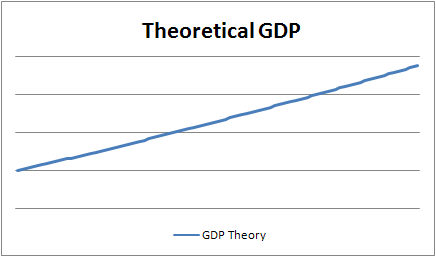
Most of the time, that’s what happens. There are a few bumps and squiggles, as well as some seasonal variation, but actual GDP tends to follow the slow theoretical upward path pretty steadily, and year after year our lives get a little better. Over a few decades, the effect accumulates like compound interest, and our lives get a lot better.
Every once in a while, however, something strange happens: Instead of the nice theoretical blue line dicated by labor and capital growth, the actual GDP takes a dip for year or two, as shown by the red line in this graph:
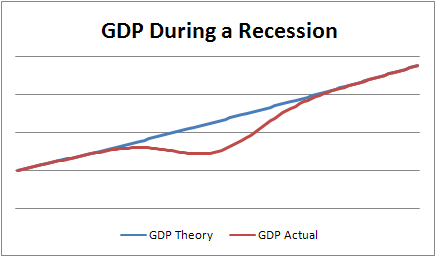
We call this a recession. Since the quality of our lives depends on the goods and services we consume, the sudden dip in available goods and services reduces the quality of our lives.
We don’t normally think of it that way, however, because of a simple fact about the GDP: All of us earn our incomes from our part in producing the GDP. So we don’t experience it as a drop in available consumer goods, we experience it as a drop in the income we have available to purchase consumer goods.
In a way, that doesn’t so bad. Look at the red line in the graph above. The bottom part of the recession dip is still above the position of the blue line at the left edge of the graph. This illustrates an interesting point: For a healthy, growing economy like ours, a recession is like taking our standard of living back in time, and usually not more than a few years back. Even if we lost a whole decade, were things really that bad in 1999?
No, but a recession to 1999 levels could still be fairly painful. First of all, our standard of living has been rising slowly for the last 10 years, but a recession would be a sudden shocking drop, which is much harder for people to handle. Second, the loss of income isn’t spread evenly across the entire workforce. Instead, most people sail through the recession with hardly any loss in income, but a few people experience devastating losses, losing their jobs and declaring bankruptcy. Third, the loss of income isn’t spread across industrial sectors. Some sectors manage to grow during a recession, while many stagnate, and a few of them (usually those already teetering on the edge of relevancy) vanish completely, taking the careers of thousands of people with them.
That’s what a recession is like, and in a fundamental way, it’s a very strange phenomenon. Remember, GDP growth is caused by increases in labor, capital, and technology. So you’d expect that one of those is decreasing in order to make GDP decrease, but which one is it?
It’s not the workforce. No plague has wiped out millions of workers. And as we all know, unemployment goes up during a recession, meaning that there’s plenty of labor available, but there isn’t anything for them to do.
It’s not capital. No nuclear war has destroyed our industrial cities. Investment does slow down during a recession, but the existing capital goods aren’t destroyed. During a recession there are tons of closed factories, empty offices, parked trucks, unused generating capacity—all the tools to produce goods and services for consumers—just waiting for someone to put them to good use.
It’s not technology. No hoards of religious fanatics have suppressed our science as a offense to their god. Technology has been improving for centuries without any backsliding. We haven’t suddenly forgotten how to make stuff.
So what the heck is going on? For some strange reason, we’ve started producing less and less instead of more and more. It doesn’t make sense. The factories are built, the workers are eager, and we know what we should be doing…but we’re not. Our economy has been overcome by madness.
Update: I have modified the second paragraph to reflect Kip’s correction in the first comment below.
Next: An explanation.
The U.S. Gross Domestic Product (GDP) is, roughly speaking, the value of everything produced for consumption in the United States in one year…”
No, GDP is everything produced by the economy, period. It includes not just consumption, but investment, government output and net exports:
Y = C + I + G + (X-M)
A major problem with the Bush administration was precisely that it defined “economic health” exclusively in terms of maintaining “consumption” — with little or no concern for who was consuming what, where the consumption came from, or how it was paid for.
Now, by contrast, we have an administration that defines “economic health” exclusively in terms of maintaining “jobs” — with little or no concern for who was employing whom, where the jobs come from, or how they will be paid for.
“Change we can believe in”?
You’re right, of course. I oversimplified. I’ve changed the paragraph to expand on this.
Thanks for the correction. I think I do okay writing about microeconomics, but this is my first attempt at macro.
I’m trying to tell, as best I can, the story of a Keynesian demand-driven Krugman-and-the-babysitting-co-op recession, and how that implies the need for a stimulus. Investment, ordinary government spending, and net exports really don’t have a place in that story.